AI Risk Calculator

How Pixel Agency built a custom AI-powered Risk Tool, giving architects and designers an instant read on whether a building is heading for a problem and putting the client in the conversation early.


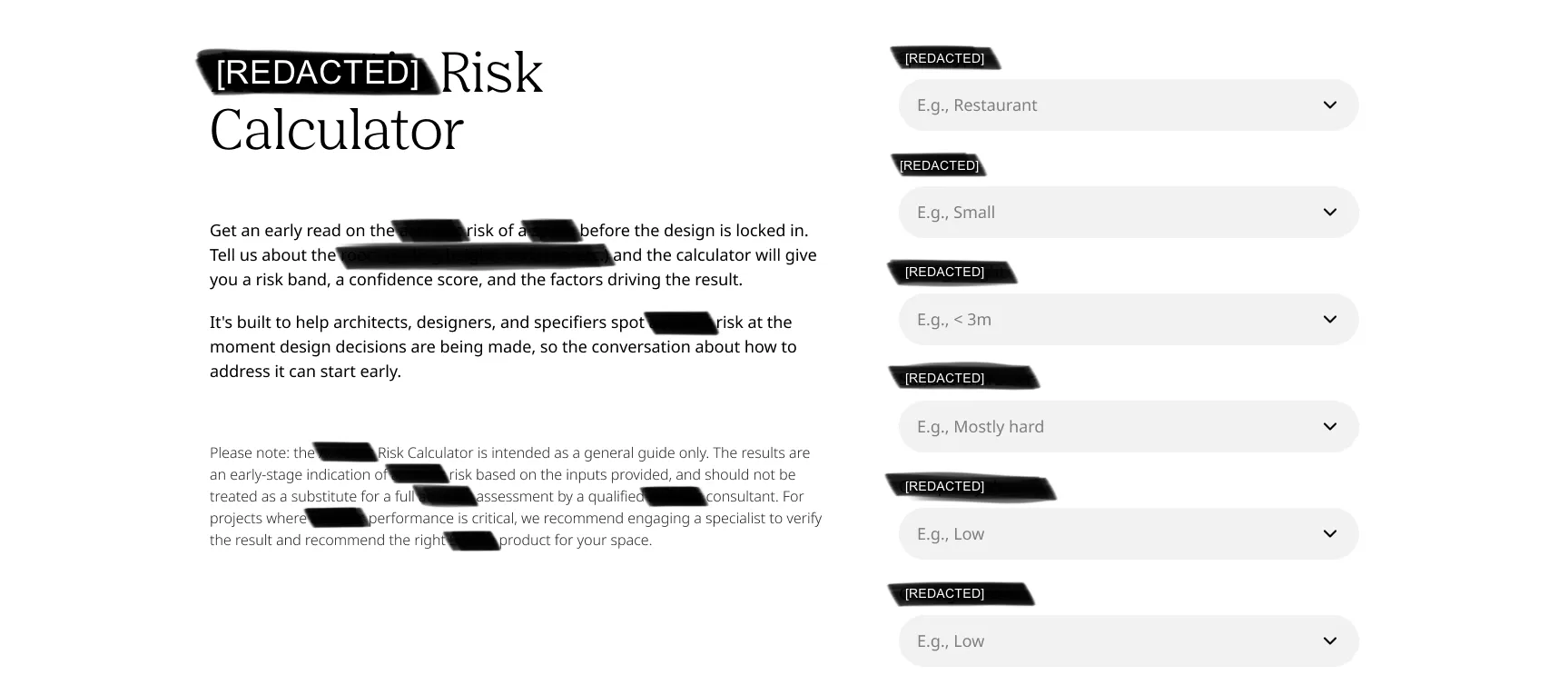
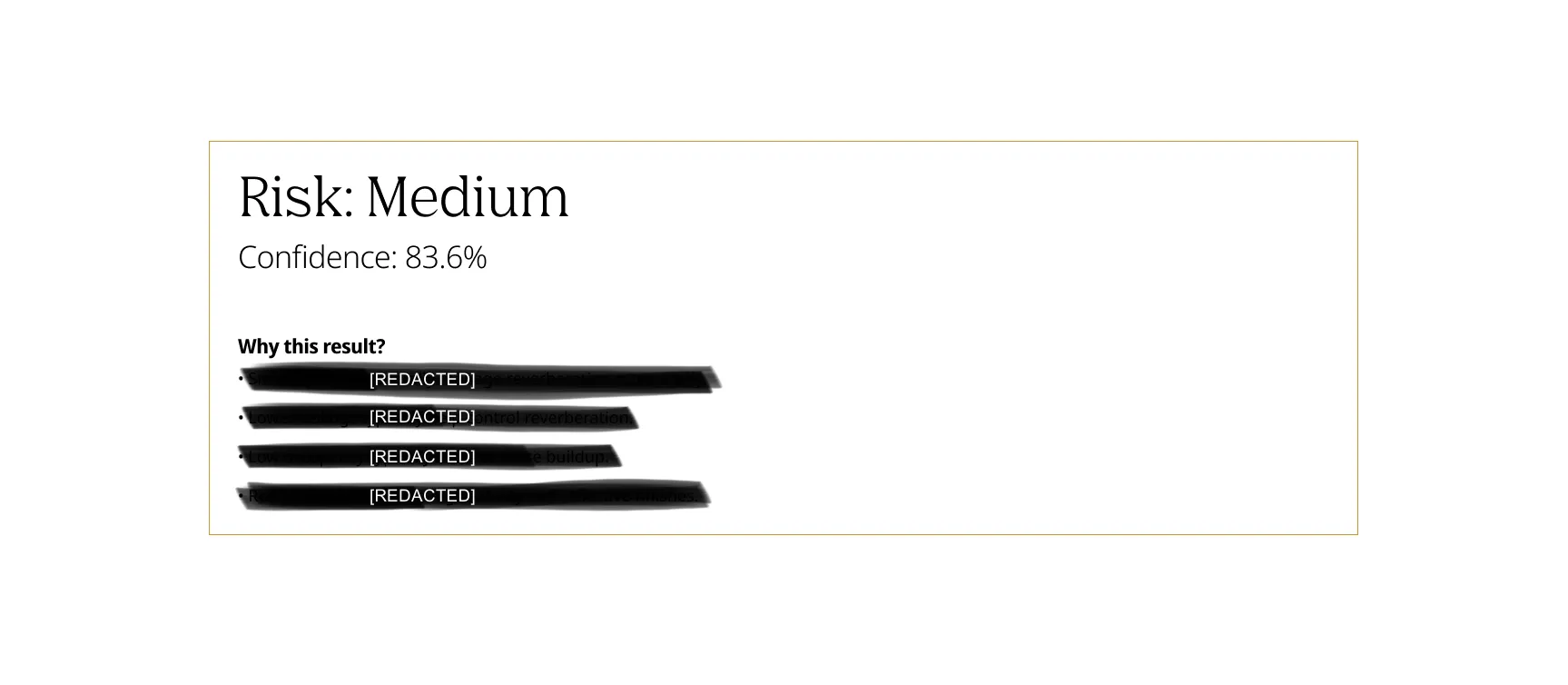
Helping architects spot risks before the design is locked in.
The client
The client is a leading Australian manufacturer of products designed for commercial fit-outs, offices, education spaces, and interiors where product performance matters. The client sells through architects, designers, and specifiers, the people who shape a space long before ground is broken in its construction. Getting the client's product specified means being part of the conversation early, when risks are still questions rather than problems.
We cannot name the client, or the problem the tool resolves here as they see the calculator as a genuine differentiator from their competition. They're planning to surprise the market with a release within the calendar year, and want to maintain that competitive advantage until launch.
The problem
Performance risk is one of those things that's hard to see until it's too late. A building can look right on a plan and still perform poorly once it's built and in use. Architects and designers don't always have an easy way to assess the performance risk of a space at the moment they're making the decisions that drive it: size, materials, etc. By the time the building is in use, the problem (and the cost of fixing it) is locked in.
The client's marketing team saw an opportunity in that gap. If the client could give architects and designers a quick, credible way to assess risks early, the client would stop being just a product to specify and start being a useful tool in the design process itself. The challenge was turning that idea into something real, technically credible, and trusted by a professional audience.
The approach
The client brought the idea to us as a differentiator they wanted to validate. Our job was to take the concept from "this could work" to "this does work" by building a working prototype that proved out the technical approach and gave the client something tangible to show stakeholders. We started by working with the client to define the inputs an architect would actually have at the early design stage, the outputs that would be useful at that moment, and the level of confidence the tool needed to project to be credible to a professional audience.
From there we designed the system around a custom AI prediction model prediction model: a CatBoost gradient boosting model trained on the relationship between building characteristics and risk outcomes. CatBoost was chosen because it handles the structured, tabular nature of the design inputs well, performs strongly on smaller training datasets, and produces calibrated confidence scores rather than the black-box guesses you sometimes get from off-the-shelf AI.
The solution
The Risk Tool is built as a self-contained, client-branded application that is designed to embed cleanly inside the client website. The architecture is deliberately lightweight: a FastAPI and Pydantic backend serving the trained CatBoost model, a client-branded front end for architects and designers, and a single dedicated server hosting the model and API. No third-party AI services in the loop, no data leaving the client's environment unnecessarily, and full control over the model and its training.
A user steps through a short, considered set of inputs and the model returns a risk band (Low, Medium, or High), a confidence score, and the factors that contributed most to the result, so the answer isn't just a number but a starting point for a design conversation. Client products are surfaced as part of the response where appropriate, putting the brand in front of architects at the exact moment they're thinking about how to bring the risk down.
The results
The tool is currently in pre-launch, with a working demonstration validated end-to-end and the model trained on representative scenarios:
A working AI tool
demonstrated end-to-end with the trained CatBoost model returning calibrated risk bands, confidence scores, and contributing factors
A custom architecture
that gives the client full control over the model, the data, and the training process, with no dependence on third-party AI services
A client-branded experience
designed to embed inside the client website, ready to drop into the live site with no disruption
Problems are cheap to fix before the building is built. After that, they're not. AI gives us the power to see the risk before it's a problem.